|
Born in 1730 to humble parents living in London, where his German-born father was a staymaker, George Berg was a favourite pupil of the eminent musical pedagogue John Christopher Pepusch, from whom he imbibed a love of the so-called ‘ancient’ music, both secular and sacred, and a liking for experiment – both in music and in chemistry, which was his cherished weekend pursuit. His output as a composer was large and diverse, embracing sonatas and concertos for instruments, voluntaries for organ (his main instrument), anthems, an Italian-language opera (the first ever written by an English composer) and, especially, songs. His secular vocal music contains a large quantity of catches, canons and glees, some of which were composed during his membership of the Madrigal Society (from 1756 until 1760), but the bulk of which were written for the amateurs of the Noblemen and Gentlemen’s Catch Club in London, active from the early 1760s onwards, which elected him to honorary membership in 1764 and on three occasions awarded him a prize at its annual competition for new compositions in each of the three mentioned categories.
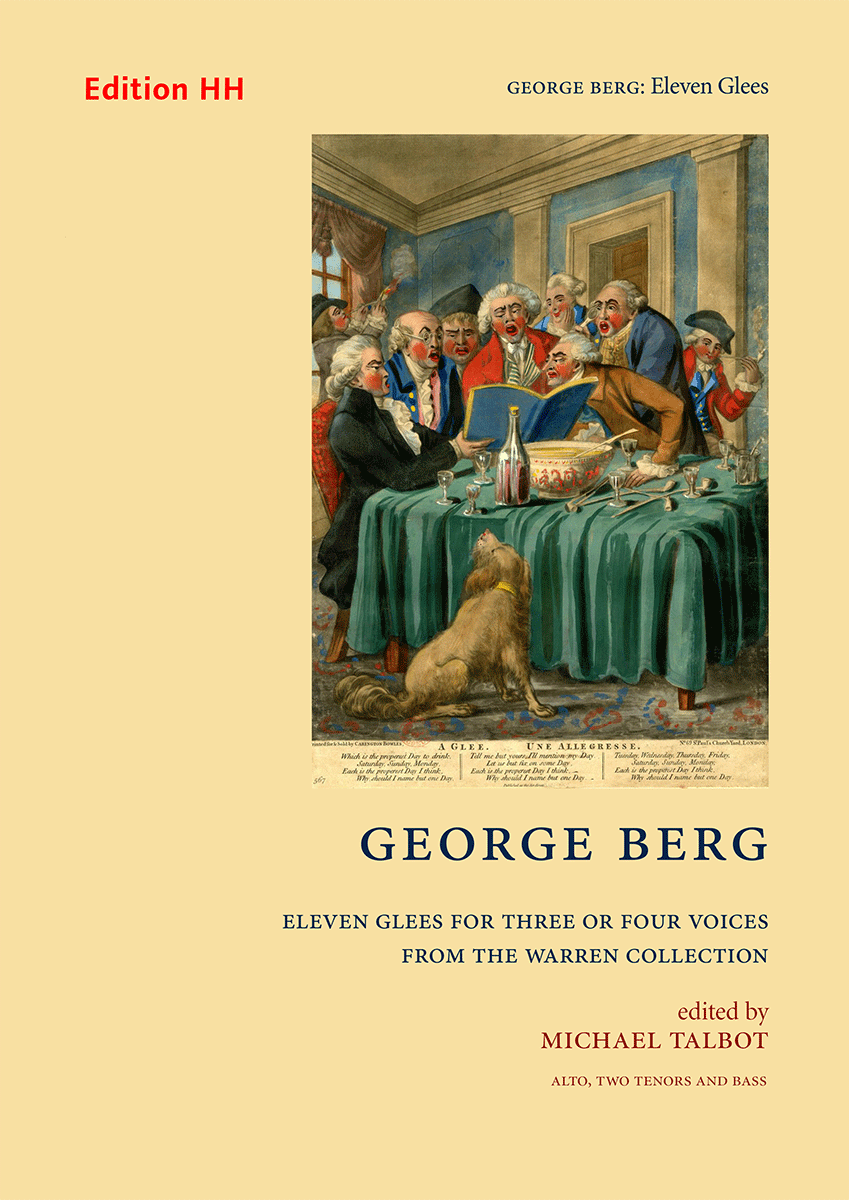
Glees represent a kind of transitional stage between the madrigals for unaccompanied voices of the sixteenth and seventeenth centuries and the part-songs composed from the nineteenth century onwards. They are for closely packed unaccompanied voices, generally all-male (a typical combination is two tenors plus bass), and they can be sung either by solo voices or chorally. Typically, they are polystrophic, each stanza of the chosen poem being set to different music. They may be either serious or light-hearted in tone. The eleven three-part and four-part glees by Berg published from 1764 to 1774, the year before his death, in the annually issued volumes of the Warren Collection (named after their compiler, the Catch Club’s secretary Thomas Warren) are fine, sensitive music that expresses the diversity the genre is capable of encompassing. Four of them reveal Berg’s great enthusiasm for Italian music (he visited Italy in 1760–62) by having Italian texts.
|
Full score
Music example: Glee 1 (pdf)