|
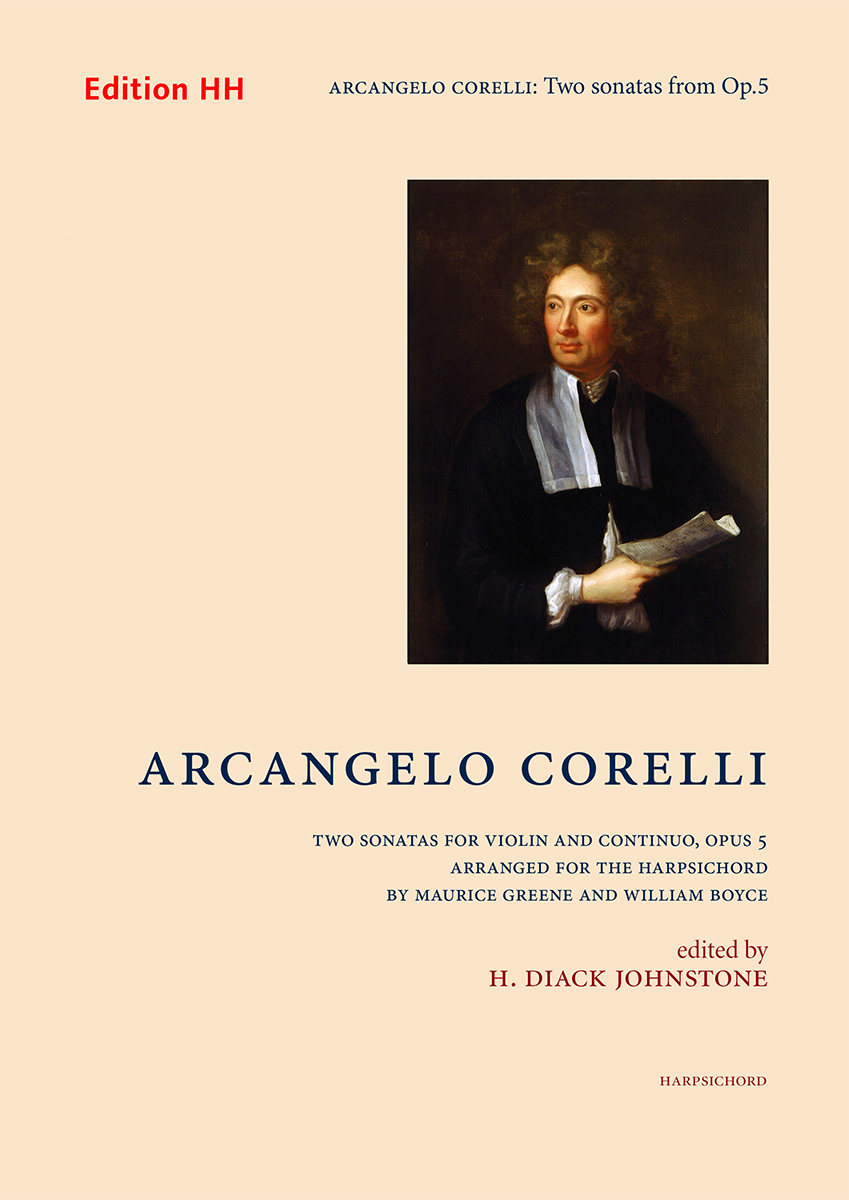
Arcangelo Corelli
Two Sonatas for Violin and Continuo, Opus 5
arr. for the harpsichord by Maurice Greene and William Boyce
ed. H. DIACK JOHNSTONE
Edition HH 648, 2025
ISMN 979-0-70821-362-8
www.editionhh.co.uk
The two sonatas are meticulously edited by H. Diack Johnstone, and beautifully presented by Edition HH, as one would expect from scholar and publisher alike.
Johnstone’s introduction to this publication in English and German, provides the history of the ownership of the manuscript book compiled by Maurice Greene for his
student, Mary Nicholson, along with other teaching pieces, in which the hand of additional copyists (pupils, including Boyce), is also evident. He repeats the notion
that Mary Nicholson gave up lessons upon her marriage in 1736; this has been overstated, as most lessons ceased before marriage, and it does not imply that she
would have ceased playing, or that music was not copied and bought after marriage. From their first appearance, Corelli’s sonatas were considered excellent material for
extensive ornamentation and diverse examples were written down, and printed, especially in Britain. Most harpsichordists will have accompanied them, and any of
these can be heard with the solo part richly and variously embellished by performers on violin, flute, or recorder from 1689 to the early nineteenth century and beyond.
This was mostly ‘through-composed melodic paraphrase of primarily slow movements’ as Neal Zaslaw describes it in his 1996 Early Music essay, adding the
quotation from Charles Burney, ‘Corelli is so plain and simple that he can always be made modern.’
Some study of other versions of Opus 5, numbers 4 & 5, would be worthwhile in deciding on a final interpretation of the two sonatas here, which seem disappointingly
unadventurous; they employ plenty of single ornaments, for which Johnstone provides a brief table, but this keyboard iteration (for a harpsichord student), is without the
ambition to add virtuosic passagi. There is no mention of inégalité within the introduction, but this might be employed in the opening adagio movement of each
sonata, along with further embellishment.
I was surprised that Johnstone did not mine his own follow-on essay for Early Music, in which he discussed Festing’s version in a manuscript instruction book that
was only recently rediscovered in 1996, and also in Greene’s hand. The friendship of these two composers may have suggested to Johnstone that this was teaching material
for Festing’s elder son, who later married Greene’s daughter. Such a relationship makes these two keyboard sonatas the more interesting, and Festing’s highly
decorated versions of Op.5, number 5, movements i and iii, is an interesting
companion-source and model for adding more embellishment, should that be a
preferable option for this more sober pair of sonatas.
With my following review in mind, I was interested to notice that John Reading had also made a keyboard arrangement, the '7th Solo of Corelli, Compos'd into a Lesson,
By John Reading' (volume (Ms. 92b), one of the several Reading manuscripts, left to Dulwich College in 1764.
PENELOPE CAVE
We are grateful to theThe Consort for permission to reproduce this review.
|