Emma Brown
My peace
SAATTB
Duration, c.2'30''
During my studies at Cambridge, I loved attending Choral Evensong. Indeed, it was the closest thing I’ve ever experienced to an addiction. The light flickering through the stained-glass windows, the beautiful set prayers, and, of course, the choral music were both soothing and uplifting. I felt calmer and more focused when I attended, and sometimes grumpy and tetchy on the evenings I did not.
When I moved to the Netherlands, I worried that I’d miss this ritual. And yet, here in Leiden, a hardworking and close-knit group of amateur singers has managed — somewhat contrary to the church's Calvinist roots — to establish an annual series of Anglican-style Choral Evensongs. I quietly regard this as a small miracle. It’s by far the most widely attended regular service in the church, and I think that says a lot about the power of music.
My Peace was commissioned by Saskia and Eric Brons to mark the tenth anniversary of the Willis Chorale. Saskia and Eric have worked for decades to promote English church music in Leiden, including helping to organise the restoration and installation of an 1892 Father Willis organ in the Hooglandse Kerk. They asked me to write a short introit for their ensemble, the Willis Chorale.
I chose My Peace because it was a text I had often heard during the D-Day commemorations in Normandy. The text stayed with me because it seemed to offer a possible answer to something I was puzzling over. When contemplating war, both past and present, it is hard to reconcile violence and cruelty with the idea of a loving deity. Yet every year in Normandy, ceremonies are widely attended by Christians who believe in a merciful God.
These words from John’s Gospel suggest that there may be a deeper peace at work, if only we can acknowledge it. Whether or not one shares the faith behind them, I find something powerful in the possibility they offer: that peace might not mean the absence of suffering or fear, but something that can exist alongside them.
I hope that, in singing or hearing these words, people will find their own meaning in them. Perhaps the most interesting thing music can do is to leave a question open – to allow us, for a few minutes, to inhabit an idea without having to decide whether we believe it.


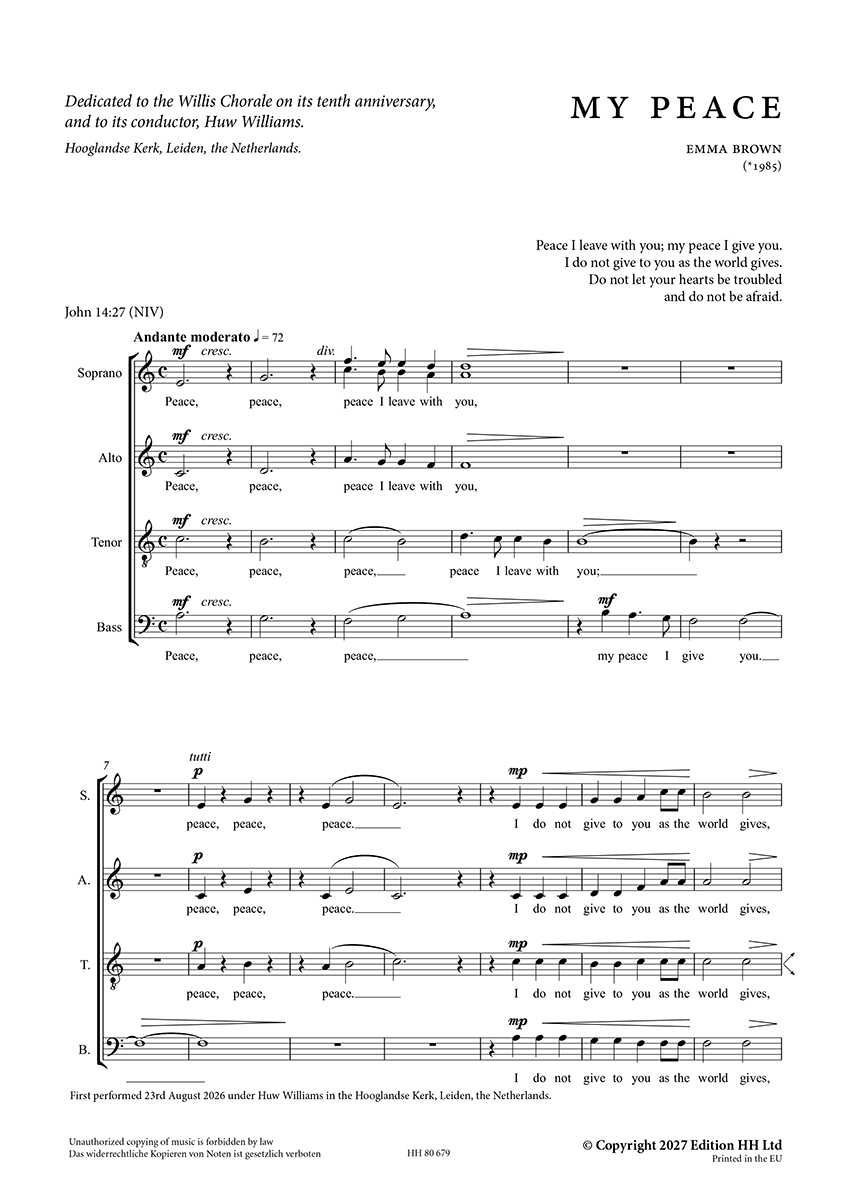
 Music example(pdf)